Le Sterf, what is? 
The STERF, Suivi Temporel des Rhopalocères de France (Temporal survey of French Diurnal Butterflies), or is a citizen science program, launched in 2005, based on the Butterfly Monitoring Scheme (BMS). It is initially conceived and supported by Association des lépidoptéristes de France (Association of French lepidopterists) and the Muséum national d'Histoire naturelle (Natural History Museum of Paris).
The STERF is a long-term, national-scale monitoring of butterfly populations. It aims to relate variations in the abundance of the species monitored to environmental modifications, for example the transformation of environments through agriculture and urbanisation, or climate change.
It is co-led by the National History Museum of Paris () (MNHN) and Opie, (French NGO, Office pour les insectes et leur environnement) (), and is supported by the French Office of Biodiversity (OFB), as part of the National Actions Plan for endangered diurnal butterflies.
The protocol
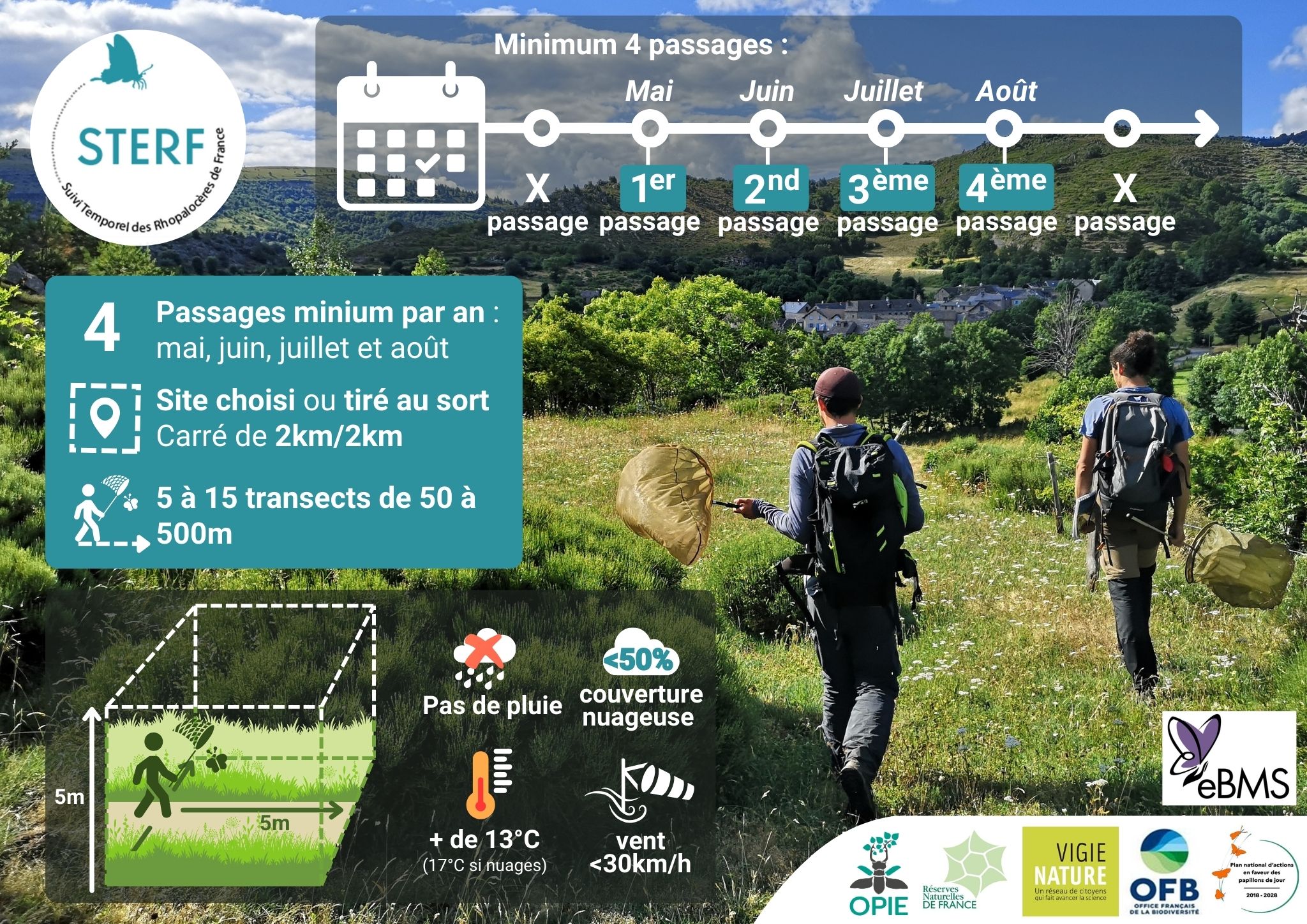
The STERF is a standardised monitoring programme: data is collected according to a simple but rigorous protocol, which ensures their reliability, and allows them to be comparable in time and space, and therefore statistically analysable.
This protocol is based on the use of fixed routes (transects), visited regularly, on which butterflies are identified and counted. The method, invented in the 1970s in Great Britain, makes it possible to produce very reliable data on common butterfly populations and to help assess their conservation status.
Butterflies are identified and counted in an imaginary box of 5m sides around the observer who moves along a predefined route (transect).
Do you want to be part of the adventure? Join the Sterf community!
The coverage of the French territory deserves to be expanded: if, like thousands of volunteers across Europe, you want to contribute to the improvement of knowledge and protection of these emblematic insects, you can create and monitor a site not far from your home or workplace! All you need to do is to be able to identify the common species present in your area.
Before you start, don't hesitate to contact the programme coordinators: [email protected], who will be able to give you advice on the protocol, how to position your transects, how to carry out the monitoring, how to enter your data, etc…
Register your data
You can register your transect data in two ways, the two tools of eBMS:
1. eBMS website
You can take notes doing your transect and write down the butterflies seen using a Field sheet. After that, you can enter that data on the website. In this pdf, we explain how you can do it or just watch this video.
2. Butterfly Count app
Another way of registering your data is using the ButterflyCount application, it is an ideal tool to do your monitoring and count directly on the field. It is free of charge and available on the following application download platforms

It has been designed and developed to facilitate field surveys, and to send your data very quickly so that they are available to researchers!
For more information on the application, see the dedicated page
We need everyone's experience, everyone's point of view, come forward to be part of the dynamic, and don't hesitate to pass on the information!
3. Butterfly Identification
Field Guide Temperate Plains of France
This Field Guide aims to facilitate the task of field identification of the 95 most common butterfly species seen in Temperate Plains of France (Western part of the country). Inside the field guide, butterfly species have an eye symbol in different colors depending on the difficulty to identify them in France.
Temperate Plains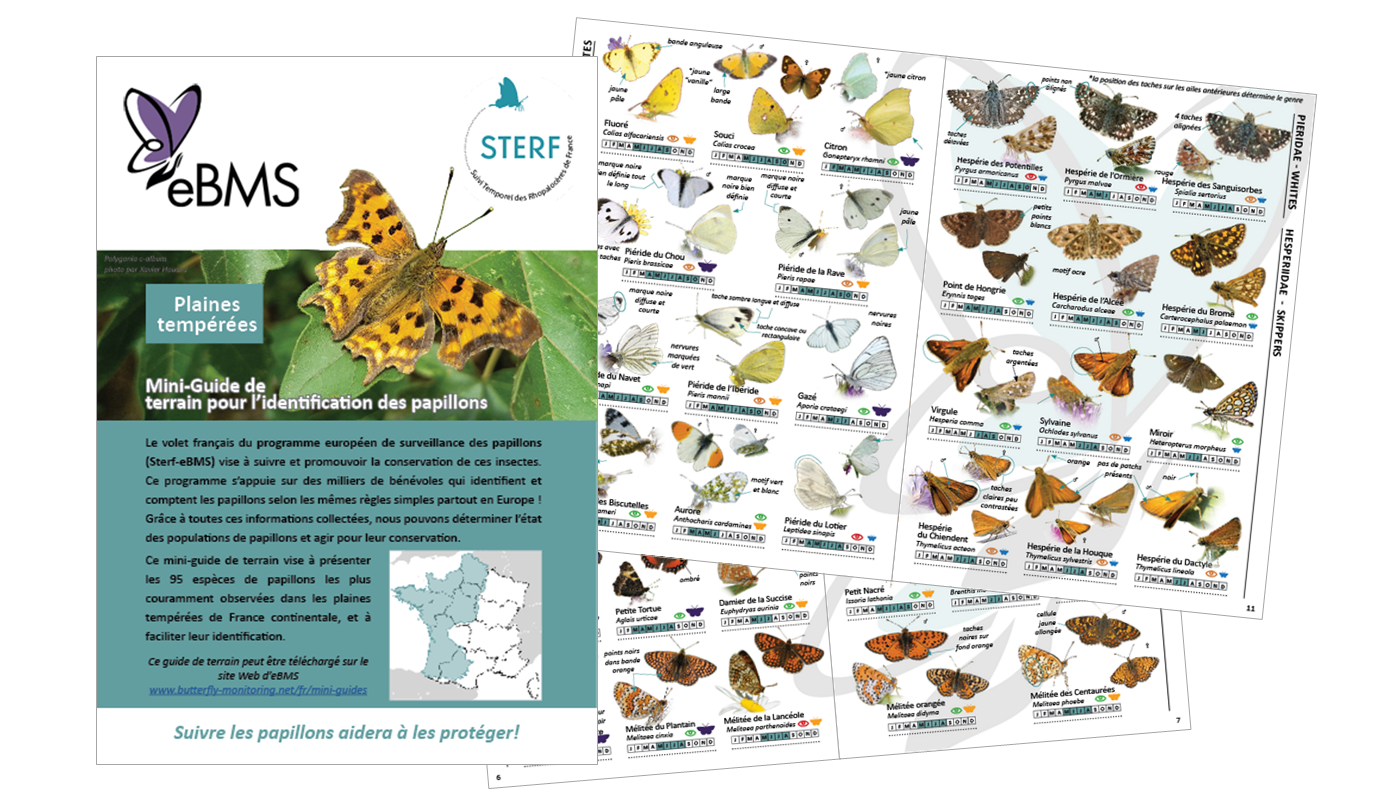
This Field Guide aims to facilitate the field identification of the 95 most common butterfly species in the temperate plains of France (the Western part of the country).
Mediterranean & Corsica
This Field Guide aims to facilitate the field identification of the 98 most common butterfly species found in the Mediterranean areas and Corsica (the eastern part of the country).
These Field Guides have been produced in collaboration with OPIE (Office pour les insectes et leur environnement) and the National Museum of Natural History (Paris) who are coordinators of the France BMS (STERF) and thanks to the support of the EU SPRING project and BCE. In the field guide, butterfly species have an eye symbol in different colors depending on the difficulty of identifying them in France, and with a lot of information about each species to easily identify them.
Contact us
Partners of France BMS, le Sterf :